technology

One sample, two flows,
lab-grade results.

Our dual-flow Lab-on-a-Chip architecture, scFv-HRP fusion antibody strategy, and AI-assisted smartphone reader deliver enzyme-amplified, naked-eye-readable diagnostic results from a single user step. Below: how it works, and the published evidence behind it.

the gap

Why current single-flow LFAs fall short.

A vertically stacked dual-flow architecture that delivers enzyme-amplified,
naked-eye-readable results from a single user step. No reader, no lab, no compromise.

Conventional lateral flow assays consist of a single planar strip with sample, conjugate, nitrocellulose, and absorbent pads arranged in series. All reagents and sample flow through one continuous capillary path. This architecture made LFAs ubiquitous in point-of-care diagnostics, but it also couples immunorecognition and signal generation into a brief, poorly controlled time window as the fluid front passes the test line.

As a result, the only WHO-endorsed urine-based POC test for tuberculosis (LF-LAM) achieves only ~40-50% sensitivity overall, restricting its use to seriously ill people living with HIV with CD4 cell counts below 200 cells/mm³.

Signal-enhancement approaches like enzyme-based amplification with chromogenic substrates can improve sensitivity, but they typically add reagent loadings or timed incubations that undermine sample-in-answer-out simplicity. The dual-flow architecture solves this.
Dual-Flow Architecture

Sequential reagent delivery from a single sample loading.

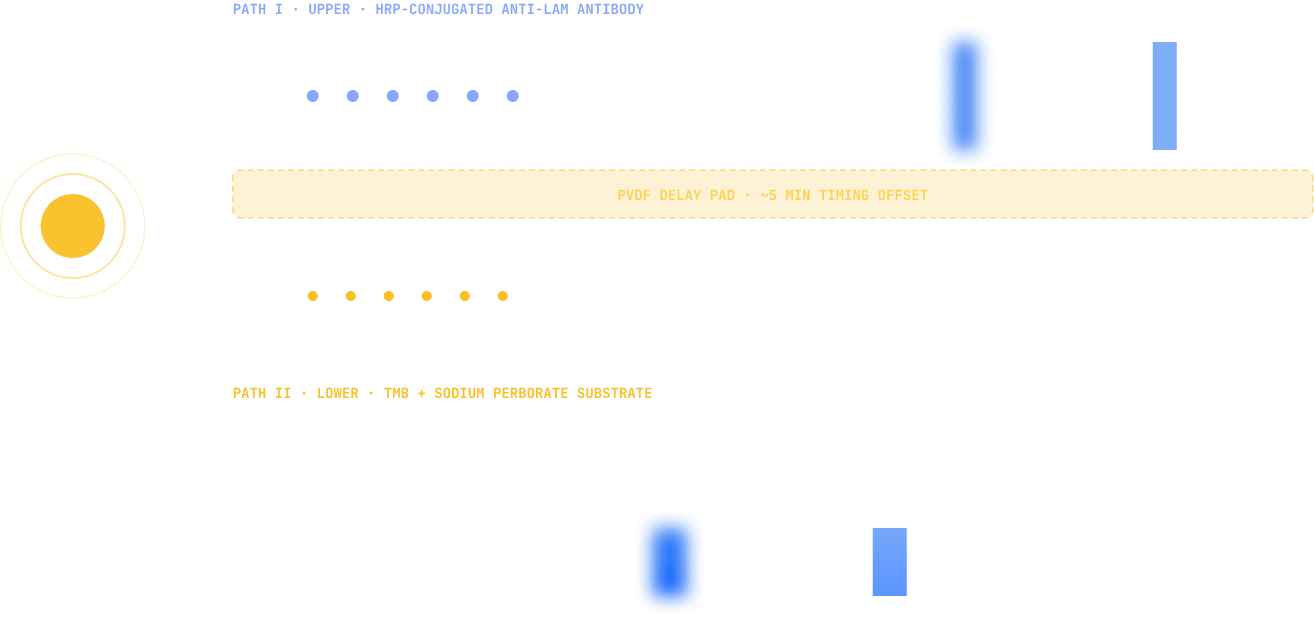
Vertically stacked upper and lower paths separated by an engineered delay pad. One user step. No reader required.
01
Vertically stacked dual flow
Upper path with dried HRP-conjugated detection antibodies, lower path with dried TMB and sodium perborate substrates, separated by a hydrophilic PVDF delay pad.
02
Engineered ~5-minute delay
The delay pad creates a controlled timing offset via differential wicking. Upper path forms the sandwich immunocomplex first; the substrate arrives second to amplify the signal.
03
Single 120 µL urine loading
No wash step, no additional reagents, no user intervention. Result visible to the naked eye within 15 minutes.
04
Cost-disruptive manufacturing
Commodity lateral-flow materials (nitrocellulose, glass fiber, wicking pads) plus low-cost TMB/HRP reagents. Per-test cost target below US$1.
reader comparison

Enclosure vs. Smartphone

Enclosure Reader
Fixed, controlled by LED
Fixed focal length
Always perpendicular
Requires hardware
> US$100
Better absolute accuracy
Smartphone Reader
Variable ambient light
Variable based on user
Phone only
$0 (existing device)
AI assists, not better than enclosure
AI-Assisted Smartphone Reader

From phone camera to quantified result, in 9 steps.

A computational color-calibration and normalization pipeline
that compensates for variable ambient lighting, angle, and distance on any phone.

STEP 01
Camera Capture
User photographs the strip inside an on-screen alignment guide.
STEP 02
QR Code Detection
ML model locates the QR on the cartridge and returns a bounding box in pixel space.
STEP 03
Card Corner Derivation
QR box dimensions plus known card aspect ratio (4:1) yield four corner points geometrically.
STEP 04
Perspective Warp (Homography)
Four corners produce a rectified 150×600 px canonical image, correcting angle, distance, and tilt.
STEP 05
Luminance Check
Image is rejected if average brightness falls below threshold (too dark).
STEP 06
ROI Placement
Reading window, test line ROI, and control line ROI placed on the canonical image.
STEP 07
Blue Channel Extraction
Mean blue channel intensity per ROI, normalized to 0–1.
STEP 08
Ratiometric Normalization
T/C = Stest / Scontrol, cancelling ambient lighting variation.
STEP 09
Calibration & Result
T/C ratio mapped to concentration via calibration curve. Output: Negative / Low Positive / High Positive / Invalid + concentration estimate.
Performance

Validated against the WHO Target Product Profile.

TB-LAM LoD (current)
980 pg/mL

Hilton Head Workshop 2026

TB-LAM LoD (target)
<100 pg/mL

>10x improvement underway

cTnI LoD (platform)
100 pg/mL · 15 min

Anal. Chem. 2025, 97, 7138-7147

WHO TPP threshold
≥65% / ≥98%

Sensitivity / Specificity

Science

Publications, Conferences & IP.

Publication
A new chemiluminescence-based rapid diagnostic testing platform with sequential dual-flow strips for cardiac troponin I (cTnI)

Analytical Chemistry · 97, 7138–7147
Jang, Setty, Ahn

Conference
A New Dual-Flow Strip Platform with High-Sensitive Colorimetric Assay for Detecting TB-LAM in Urine (2026 5.31 ~ 6.4)

Hilton Head Workshop 2026
Setty, Jang, Kim, Park, Seo, Ahn

Publication
Biomedical Microdevices
Underlying platform reference for BQL-Stress

Analytical Chemistry · 97, 7138–7147
Jang, Setty, Ahn

Next-generation In Vitro Diagnostics, built on dual-flow Lab-on-a-Chip technology licensed from the University of Cincinnati.

Products described on this site are in development. They have not been cleared or approved by the U.S. Food and Drug Administration (FDA) or any other regulatory authority. They are not yet available for sale.

© 2026 BQL Healthcare USA Inc. All rights reserved.